
Matt’s Notes
Hey there, and welcome to season five. episode two wherein we’re extolling handwriting and associated educational applications, and no doubt going down rabbit holes of various varieties as well! Thanks for joining us!
We’re looking and speaking as correctly as we can, under the circumstances! #ednontech
This audio’s got more trouble than it can handle, probably! #ednontech

Doug’s Notes
Handwriting over typing
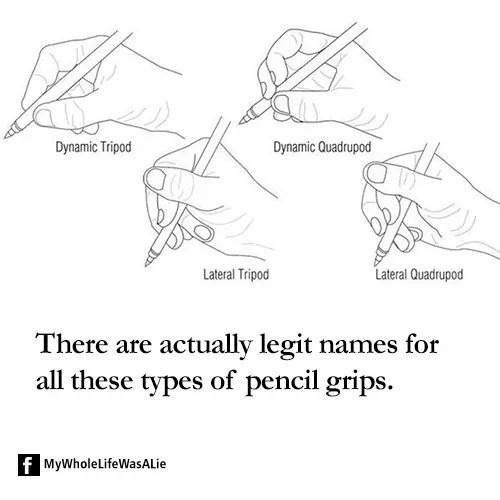
Of that august personage, a pedagogue in a district school, under whose inspection (and spectacles) we took our first lessons in the chirographic art, we have this distinct recollection : Whenever he announced the ” time to write,” and we were fairly at work with pen, rule, plummet, and copy, he seldom failed to add, with a good deal of emphasis, this special direction in regard to the exercise : “Let it be short, very short”
APS. (1858). Education in the hand of penmanship. The Massachusetts Teacher (1858-1871), 138-143.
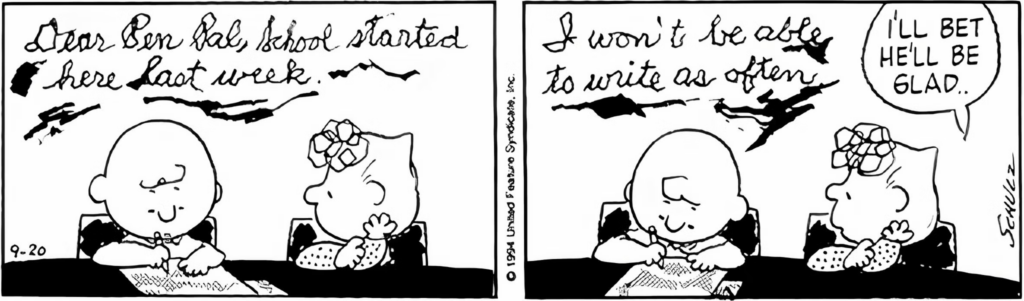
Handwriting has a low status and profile in literacy education and in recent years has attracted little attention from teachers, policy makers or researchers into mainstream educational processes.
The research suggests that the role of handwriting in writing has been underestimated in mainstream education.
Shaturaev, J. (2019). The importance of handwriting in education. International Journal of Advanced Research.
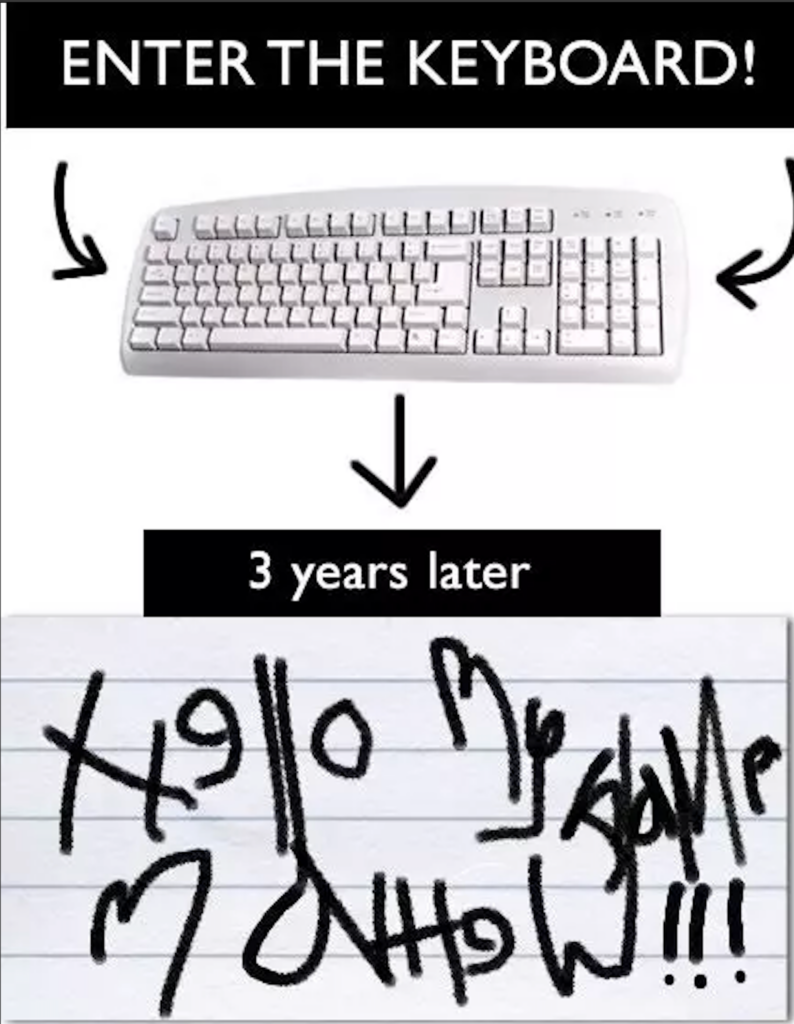
Handwriting requires fine motor control over the fingers, and it forces students to pay attention to what they are doing. Typing, on the other hand, requires mechanical and repetitive movements that trade awareness for speed.
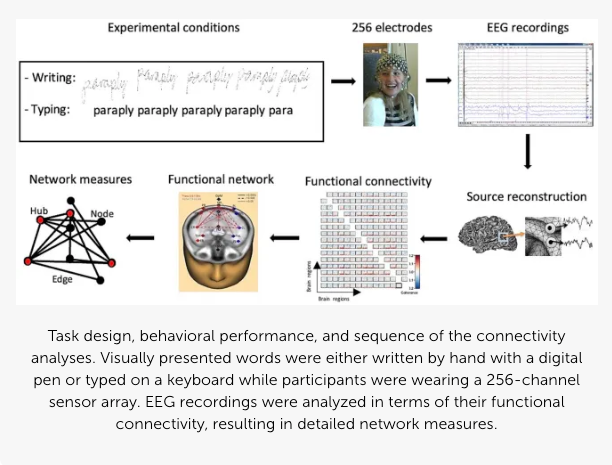
Thus, the ongoing substitution of handwriting by typewriting in almost every educational setting may seem somewhat misguided as it could affect the learning process in a negative way
Van der Weel, F. R., & Van der Meer, A. L. (2024). Handwriting but not typewriting leads to widespread brain connectivity: a high-density EEG study with implications for the classroom. Frontiers in psychology, 14, 1219945.
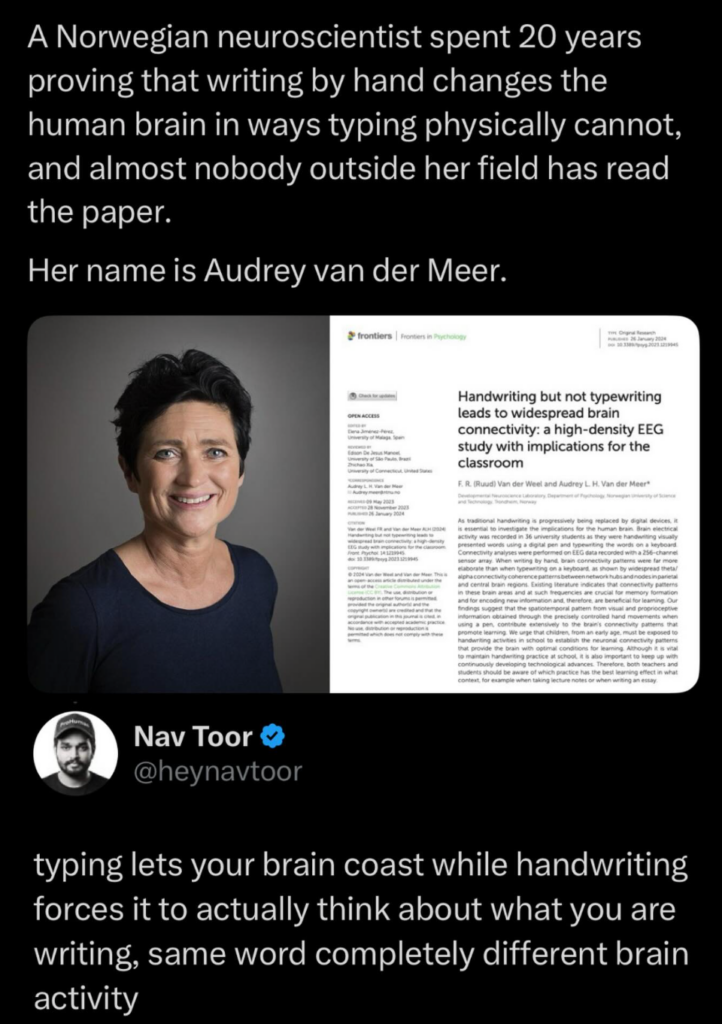
Handwriting activates a broader network of brain regions involved in motor, sensory, and cognitive processing. Typing engages fewer neural circuits, resulting in more passive cognitive engagement.
By understanding the neural differences between handwriting and typing, we can gain insights into optimal learning strategies and potential cognitive advantages, in order to optimize educational, cognitive, and psychological methodologies.
We can consider handwriting and typing as distinct yet related modalities of written communication, each employing overlapping but specialized neural circuits. The unique demands of handwriting versus typing shape cognitive development and brain activity, rooted in our evolutionary history and present-day technological habits. The neuroscientific evidence highlights the cognitive advantages of handwriting in learning environments, particularly for younger learners.
Marano, G., Kotzalidis, G. D., Lisci, F. M., Anesini, M. B., Rossi, S., Barbonetti, S., … & Mazza, M. (2025). The neuroscience behind writing: Handwriting vs. typing—Who wins the battle?. Life, 15(3), 345.
The use of typing as an accommodation reflects the change in writing habits that has taken place since the introduction of the personal computer in the 1980s, with typing taking a more prominent place in text composition in both personal, educational and professional contexts
Stuart, N., & Barnett, A. L. (2026). Handwriting and typing in students with and without additional needs in higher education: Product, process and perceptions. Journal of Research in Special Educational Needs, 26(1), e70058.
Word of the Podcast
Penmanship
Question of the Podcast
What other older pedagogy are not improved by recent developments?
Phrase of the Podcast
Doing her fibre arts
&
Short sighted and misguided

Click, clack, click
Go the cameras and my face in black and white
But I’ll be black and blue before tonight #ednontech

Podcast: Play in new window | Download
