
Matt’s Notes
Welcome to our fourth episode of season four here at the EnT! We’re grateful you’ve joined us for this discussion on learning away from our home communities! Doug and I have both spent significant time overseas in our careers thus far, and it’s fair to say that this topic also has much to do with the current educational context here in Canada, as well as distance education generally!
From our respective communities to yours with #ednontech!
You can be assured this audio has travelled far and wide to land here! #ednontech

This was a compelling topic for me for any number of reasons.
As we discuss in the recording, there are many benefits to studying and/or teaching anywhere other than your home community. As per Ruperti (2009) whom Doug cites below, there seems to be a positive correlation between studying abroad and academic benefits, including going on to further study. My earliest experiences as a teacher are tied to travel, and similarly are tied to my further education. For example, when my then-spouse and I went to South Korea, it was specifically so that I could gain experience as a teacher so as to be able to gain entry into a Bachelor of Education (B.Ed) program. Upon completion of the program, I then went to Qatar while at the same time working on a Masters of Education (M.Ed) from one of my local institutions of higher learning in Fredericton, New Brunswick. The fact that I was able to complete the University of New Brunswick (UNB’s) M.Ed through a primarily distance-based format was valuable from the standpoint enhancing my interest in e-learning and distance-based learning generally. This experience, in turn, led directly to my decision to focus on e-learning within the context of an education doctorate (Ed.D) in educational technology. The Ed.D was delivered through a blended format, which allowed me to start the program in Qatar and finish it in Oshawa, Ontario.
Throughout my adult life I’ve lived in Fredericton, NB; Halifax, NS; Montreal, QC; Seoul, South Korea; Doha, Qatar; Oshawa, ON; Kamloops, BC; Saint John, NB; and Fort McMurray, AB. In all these places I learned things about myself and about the world which would have otherwise gone unnoticed. As Doug pointed out in the recording, once you start to travel you will find new and unique opportunities for personal and professional growth. Sometimes that growth will be painful. The immediate analogy which comes to mind when I consider this is of muscle tissue being broken during exercise in order to grow back stronger. As Google AI has it, this is “a process sometimes referred to as micro-tears, which triggers a repair and rebuilding process called muscle hypertrophy”. Constantly going outside your comfort zone, as you must when travelling, builds up flexibility of mind, situational awareness, cultural literacy, and a whole host of other benefits over time.
Inasmuch as travelling for education and work has been part of my life since I was twenty years old, I am now looking ahead to a future which may include going elsewhere in Canada or returning to Asia or possibly other locales which I can only guess at. While my strongest desire is to be in BC close to my kids, I recognize that my history is of going other places to work and study, and that the greater good from a professional and financial standpoint may be to present myself somewhere far away for the benefit of potential employers, wherever they may be. This greater financial and professional good has direct material connection to my kids’ opportunities and well-being generally.
Once you have travelled for a significant time the habits of that passage, the adjustments you need to make, the constant tests while moving from one location and experience to another, all inform who you are when you are back in your home community. You are a different person than when you left and the value you bring to any interactions with others, whether in a teaching and learning context or otherwise, is informed by that experience.
Thanks to Doug for a choosing a topic that resonates across the decades and across the continents!

Doug’s Notes
Learning away from your home community
There is no longer the same necessity for crossing the Atlantic for an education that existed some years ago … To such, especially if women, a few notes, suggestions, and addresses will prove useful in simplifying the modus operandi of settling in a foreign city.
Nieriker, M. A. M. A. (1879). Studying Art Abroad, and how to do it cheaply. Roberts Brothers.

Most participants reported that they enjoyed living and studying in Australia and they were appreciative of freedom of living alone, being relatively less controlled in their everyday life, being in a friendly environment, and acquiring a quality education. They also took advantage of a diverse range of opportunities that were not readily available in their home countries.
Han, G. S., Jamieson, M. I., & Young, A. E. (2000). Schooling in rural New South Wales: The experience of overseas students. Journal of Family Studies, 6(2), 272-279.

- Forty-six percent of full-year students reported acquiring graduate degrees. They were twice as likely to attain a Ph.D. degree (7%) than students attending shorter terms (3%).
- Students who studied abroad for a full year were twice as likely to cultivate lifelong friendships with host-country nationals. Lasting relationships take time to develop.
- Achieving greater understanding of one’s own cultural values and biases, continuing to be influenced in one’s interactions with people from different cultures, and developing a more sophisticated way of looking at the world are all strong findings
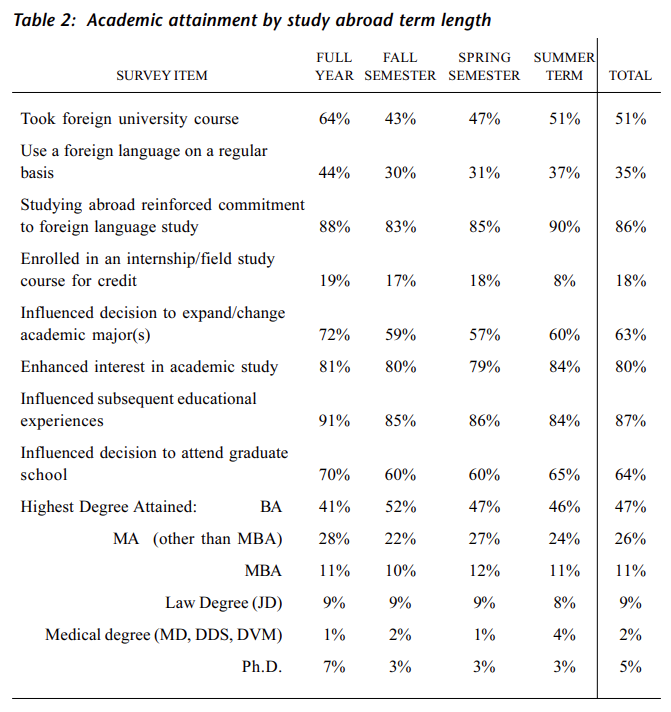
Ruperti, B. (2009). Tanizaki and the Way of Art (Geido): Traditional Arts and Performance Skills. The Grand Old Man and the Great Tradition, 97.

Three main themes emerged when participants were asked what they had learnt from their time away.
- The first was an appreciation of the healthcare system in their home country. This appeared to both surprise and please the participants and may have contributed to their decision to return to their home country.
- The second theme was the recognition of the need to establish an adequate work–life balance. Most participants found this realisation to be positive, enabling them to establish a healthier relationship with work on returning home.
- The third theme suggested that time spent working overseas increased motivation for training. Participants’ overseas experience had left them more mature and better able to deal with the pressures of postgraduate training.
Fox, T. A., Byrne, G., & Byrne‐Davis, L. M. (2018). The educational impact of experience overseas. The Clinical Teacher, 15 (4), 298-303.

… effective strategies for flourishing while overseas provide preliminary data which suggest that acculturation phenomena provide growth opportunities. …Flourishing can be linked with acculturation. The participants who set goals for themselves felt proud when they accomplished them, and served to reinforce their sense of belonging
Stasel, R. S. (2021). Educator acculturation while living and working overseas: Stories from seventeen sojourning teachers and school leaders at international schools (Doctoral dissertation, Queen’s University (Canada)).

I let the quokkas in 🙂
Rottnest Island, Western Australia
Word of the Podcast
Overseas / International
Question of the Podcast
How can more people get the opportunity to embrace teaching and learning opportunities away from their home communities?
Phrase of the Podcast
Became Canadian

Thanks for checking out this EnT, wherever in the universe you happen to be!
Images of broken light which dance before me like a million eyes
They call me on and on across the universe
Thoughts meander like a restless wind inside a letterbox
They tumble blindly as they make their way across the universe #ednontech
Podcast: Play in new window | Download
